

You’re exhausted. You’ve been exhausted for a while. But you can’t figure out what to call it.
Is it stress? Burnout? Or something deeper?
This is one of the most common questions I hear from high-achieving women. They know something is wrong. They feel it in their body, in their patience, in the way they wake up already dreading the day. But they can’t pin down which label fits – and that confusion delays the right response.
Here’s why it matters. Stress, burnout, and depression share symptoms, but they aren’t the same condition. They don’t have the same causes. And they don’t respond to the same solutions.
If you treat burnout like ordinary stress, you’ll keep pushing through something that requires structural change. If you mistake depression for burnout, you may avoid the clinical support that could genuinely help. And if you dismiss all three as “just being tired,” you risk letting a manageable problem become a serious one.
Let’s break it down.
What Stress Actually Is
Stress is your body’s response to external pressure. It’s a reaction, not a condition.
When you face a tight deadline, a difficult conversation, or an overwhelming workload, your nervous system activates. Cortisol rises. Your focus sharpens. Your body prepares you to handle the demand.
In short bursts, stress can actually improve performance. It creates urgency. It drives action. The problem isn’t stress itself – it’s stress that becomes constant.
Chronic stress looks like:
- Feeling pressured but still engaged with your work
- Trouble sleeping because your mind won’t stop racing
- Irritability and emotional reactivity
- Physical tension – headaches, tight shoulders, digestive issues
- A sense that there’s always too much to do and not enough time
The critical distinction: with stress, you still care. You’re overwhelmed, but you’re not disconnected. The work still matters to you.
Stress is characterized by overengagement. Too much energy. Too much urgency. Too much emotional reactivity. Your system is in overdrive.
That’s very different from what happens next. And if you’ve ever wondered why successful women burn out faster despite their competence, the answer begins here – with how stress evolves when it never gets resolved.
What Burnout Actually Is
Burnout isn’t just extreme stress. It’s what happens when stress continues without adequate recovery for too long.
The World Health Organization classifies burnout as an occupational phenomenon with three defining characteristics: feelings of energy depletion or exhaustion, increased mental distance or cynicism toward your job, and reduced professional efficacy.
That last part matters. Burnout doesn’t just make you tired – it changes how you relate to the work itself. With stress, you feel too much. With burnout, you start to feel too little.
Burnout looks like:
- Emotional numbness or detachment from responsibilities you once valued
- Feeling drained even after rest or time off
- Cynicism toward your job, your team, or your own efforts
- Reduced motivation and declining performance
- A sense that nothing you do makes a meaningful difference
- Mental fatigue at work that no amount of sleep seems to fix
This is where many high-achieving women get stuck – because burnout doesn’t always look like collapse. Often, it looks like someone still performing but gone hollow inside. You’re delivering results but feeling nothing about them. You’re leading but quietly resenting every demand placed on you.
The patterns that create success – constant overperformance, dependability, perfectionism, emotional labor – are the same patterns that accelerate burnout. This is where working with a physician career coach becomes essential. Not to slow you down, but to help you sustain excellence without self-destruction.
Burnout is characterized by disengagement. Not too much energy – not enough. Not overwhelm – emptiness. Your system is shutting down to protect itself.
And that brings us to the third possibility.
What Depression Actually Is
Depression is a clinical mental health condition. Unlike burnout, it isn’t limited to one area of your life. It affects everything.
According to the National Alliance on Mental Illness (NAMI), major depressive disorder involves persistent feelings of sadness, hopelessness, or emptiness lasting at least two weeks, along with symptoms like loss of energy and reduced functioning. It impacts your ability to function at work, at home, in relationships, and even in activities you once enjoyed.
Depression looks like:
- Persistent sadness or emotional flatness that doesn’t lift
- Loss of interest in things that used to bring joy – not just work, but hobbies, relationships, daily life
- Feelings of worthlessness or excessive guilt
- Difficulty concentrating or making decisions
- Changes in appetite or weight
- Sleep disturbances – insomnia or sleeping too much
- In severe cases, thoughts of self-harm or suicide
The key difference is scope. Burnout is situational – usually tied to specific roles, environments, or responsibilities. Depression is pervasive. It follows you everywhere, regardless of circumstance.
A person experiencing burnout may feel relief on vacation. A person experiencing depression often doesn’t. The environment changes, but the internal experience stays the same.
Research published in the Journal of Affective Disorders has explored whether burnout and depression are truly separable conditions. While they share overlapping symptoms – particularly emotional exhaustion and reduced performance – the evidence suggests they are distinct experiences with different underlying mechanisms, with depression involving more severe social withdrawal and anhedonia.
This distinction isn’t academic. It determines what kind of support actually works.
The Overlap That Creates Confusion
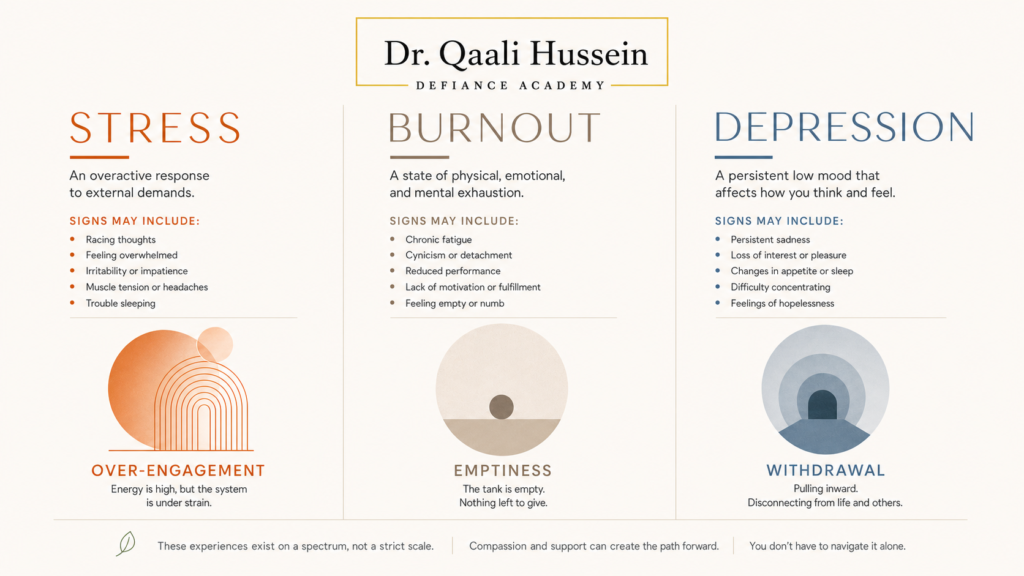
The reason so many professionals struggle to distinguish between burnout, stress, and depression is that all three share visible symptoms.
All three can cause:
- Fatigue and low energy
- Difficulty concentrating
- Sleep disruption
- Emotional instability
- Reduced motivation
From the outside, they can look identical. That’s what makes self-diagnosis unreliable – and why so many women spend months or years applying the wrong solution.
You try to manage burnout with a vacation, but the exhaustion comes back within days because the structural problem was never addressed. You treat depression like workplace stress, assuming a job change will fix something that actually requires clinical intervention. Or you push through genuine burnout because you believe you’re just stressed and need to be tougher.
Each misidentification has a cost. And for high-performing women, that cost compounds quickly.
How to Tell the Difference: A Side-by-Side Breakdown
Here’s a direct comparison to help you identify what you may actually be experiencing.
| Dimension | Stress | Burnout | Depression |
|---|---|---|---|
| Primary emotion | Anxiety and urgency | Emptiness and detachment | Sadness and hopelessness |
| Energy pattern | Hyperactive, restless | Depleted, flat | Low, heavy |
| Engagement | Over-engaged | Disengaged | Withdrawn from everything |
| Scope | Usually situational | Tied to specific roles | Pervasive across all life areas |
| Response to rest | Often improves | May not improve without change | Doesn’t resolve with rest alone |
| Self-perception | Overwhelmed but capable | Cynical and ineffective | Worthless or guilty |
| Duration trigger | Acute pressure | Prolonged unrecovered stress | Can emerge without external cause |
| Support needed | Lifestyle adjustments | Coaching and structural redesign | Therapy and possibly medication |
Table 1: Comparison of stress, burnout, and depression.
This isn’t a diagnostic tool. But it can help you stop guessing and start getting accurate about what you’re actually experiencing.
Not sure where you fall? Take the career diagnostic to get clarity in under 2 minutes.
Why Mental Fatigue at Work Gets Misread
Mental fatigue at work is one of the earliest warning signs of burnout. It’s also one of the most commonly dismissed.
When your brain feels foggy, when decision-making feels harder than it should, when you can’t focus even on tasks you know well – that isn’t laziness. It’s your cognitive system signaling overload.
For many professionals, especially women in leadership, mental fatigue becomes normalized. You assume everyone feels this way. You tell yourself it’s just part of the job.
But persistent mental fatigue is often the bridge between stress and burnout. A 2025 review in Frontiers in Public Health identified persistent fatigue, impaired concentration, and poor sleep quality as key intrapersonal early warning signs of burnout – symptoms that are commonly missed until the condition has already become chronic.
If you’re already feeling drained despite your success, mental fatigue may have been present longer than you realize. And the longer it goes unaddressed, the more likely it is to progress into full emotional exhaustion.
Emotional Exhaustion: The Common Thread
Emotional exhaustion is the one symptom that appears in all three conditions. It’s also the symptom most often minimized by high achievers.
You might describe it as:
- Feeling empty after interactions that used to energize you
- Having nothing left to give at the end of the day
- Crying more easily or feeling emotionally fragile without clear cause
- Feeling detached from people you care about
- Operating on autopilot through responsibilities that once had meaning
Emotional exhaustion isn’t dramatic – it’s erosive. It wears you down slowly until your emotional capacity is so depleted that even small demands feel unbearable.
For high-achieving women, this often happens invisibly. You’re still meeting every obligation. Still showing up. Still delivering. But the internal cost has become unsustainable.
Emotional exhaustion deserves serious attention. It’s not a phase – it’s a signal. And ignoring it doesn’t make you resilient. It makes the eventual breakdown harder to recover from.
When Burnout Starts to Look Like Depression
There’s a critical threshold that many professionals cross without realizing it. Chronic burnout, left unaddressed for months or years, can begin to resemble depression.
The cynicism deepens. The emotional numbness spreads beyond work into personal life. The sense of inefficacy starts to feel like worthlessness. What began as situational exhaustion becomes a generalized feeling that nothing will ever feel right again.
A systematic review and meta-analysis examining the relationship between burnout, depression, and anxiety found a positive correlation between burnout and depressive symptoms – particularly with emotional exhaustion, the core component of burnout. Prolonged burnout that goes unaddressed can become a risk factor for developing clinical depression.
This is why early intervention matters. Burnout caught early can often be addressed through structural changes, boundary work, and coaching. Burnout left to progress may eventually require clinical treatment.
If you’re wondering where you fall on this spectrum, that uncertainty alone is worth paying attention to. High-functioning people often wait too long because they assume they should be able to handle it. That assumption is part of the problem.
What to Do When You’re Not Sure
If you can’t clearly identify whether you’re experiencing stress, burnout, or depression, here are practical next steps.
- Stop self-diagnosing based on productivity. Still functioning doesn’t mean you’re fine. High performers can operate in burnout – or even depression – for months before anyone notices.
- Assess the scope. Is your exhaustion limited to work? Or has it spread into your relationships, hobbies, and personal life? Scope is one of the most reliable indicators.
- Track your recovery response. Do you feel better after time off, even briefly? If yes, you may be dealing with stress or early burnout. If rest makes no difference, the issue may be deeper.
- Evaluate emotional engagement. Do you still care about your work but feel overwhelmed? That’s likely stress. Do you feel detached and cynical? Likely burnout. Do you feel hopeless across all areas of life? That may be depression.
- Get clarity, fast. If you’d rather start with a quick self-assessment than guess, take the career diagnostic – it’s a structured way to identify what you may be experiencing and what kind of support fits.
For professionals dealing with burnout specifically, understanding how career coaching addresses the structural and behavioral patterns that stress management alone can’t fix may be an essential step toward sustainable recovery.
For those experiencing symptoms of depression, clinical support is essential and shouldn’t be delayed.
Burnout Diagnosis: Why It’s Complicated
One challenge with burnout is that it isn’t formally classified as a medical diagnosis in most clinical frameworks. The WHO’s ICD-11 classifies burnout as an occupational phenomenon – not a medical condition. It’s included in the classification specifically as a factor influencing health status, not as a standalone illness.
This means burnout often falls into a gray area. Your doctor may not diagnose it directly. Your therapist may frame it differently. And you may be left feeling like your experience doesn’t fit neatly into any category.
That ambiguity can be frustrating. But it doesn’t make what you’re experiencing any less real.
The three dimensions the ICD-11 uses to characterize burnout are:
- Feelings of energy depletion or exhaustion
- Increased mental distance from your job, or feelings of negativism or cynicism related to your job
- Reduced professional efficacy
If those three dimensions describe your experience, the label matters less than the response. Whether it’s formally called burnout or not, the patterns need to be addressed.
And for high-achieving women, those patterns are often deeply embedded – tied to identity, expectations, and environments that don’t change without deliberate intervention.
Getting the Right Support
The most important takeaway: the right response depends on the right identification.
| What you’re experiencing | What helps |
|---|---|
| Stress | Lifestyle adjustments, workload management, recovery practices, boundary setting |
| Burnout | Structural change, coaching, nervous system regulation, identity work, redesign |
| Depression | Clinical therapy, potentially medication, professional mental health treatment |
| Burnout progressing toward depression | Combined approach – both coaching and clinical support |
Table 2: Support strategies based on condition.
You don’t have to figure this out alone. And you definitely shouldn’t wait until you collapse to seek clarity.
If you suspect burnout and you’re ready to take action, start by getting clarity on what you’re actually dealing with. Take the career diagnostic to identify the patterns driving your exhaustion and the right next step for your recovery.
If your symptoms feel broader than work – if they’re affecting your relationships, your sense of self, and your ability to feel joy in any context – please reach out to a licensed mental health professional.
The goal isn’t to label yourself. The goal is to understand what’s happening clearly enough to respond effectively.
Frequently Asked Questions
Is burnout the same as being stressed?
No. Stress is a state of overengagement and emotional reactivity. Burnout is a state of disengagement and emotional depletion caused by prolonged, unrecovered stress. Stress makes you feel too much. Burnout makes you feel too little.
Can burnout turn into depression?
Yes. Research shows a positive correlation between chronic burnout and depressive symptoms. Prolonged burnout that goes unaddressed can become a risk factor for developing clinical depression.
How do I know if I have burnout or depression?
Burnout tends to be situation-specific, usually connected to work or a particular role. Depression is pervasive and affects all areas of life. If rest and time away provide some relief, burnout is more likely. If nothing helps and hopelessness persists regardless of circumstances, depression should be evaluated clinically.
What does emotional exhaustion feel like?
Emotional exhaustion feels like having nothing left. You may feel numb, detached, unable to engage emotionally, and drained even by small demands. It’s a core component of burnout and also appears in depression.
Is mental fatigue at work a sign of burnout?
Persistent mental fatigue – including brain fog, difficulty concentrating, and decision fatigue – is often one of the earliest signs of burnout. If it continues despite rest, it should be taken seriously as a potential warning sign.
Should I see a therapist or a burnout coach?
It depends on what you’re experiencing. A burnout coach addresses professional patterns, structural overload, and sustainable performance. A therapist addresses clinical mental health concerns, including depression and trauma. Both can complement each other effectively.
How can I tell the difference quickly?
The fastest way is a structured self-assessment. Take the career daignostic to map your symptoms against the patterns of stress, burnout, and depression – and get a clearer sense of which one you may be dealing with.
You didn’t work this hard to feel empty at the top.
Success shouldn’t cost your health, your confidence, or your peace.
If you’re ready to move from drained to decisive – from overwhelmed to unstoppable – start by understanding exactly what’s draining you.
You don’t need to shrink your ambition. You need a smarter way to sustain it → Take the Career Diagnostic
A 2-minute self-assessment from Dr. Qaali Hussein to help you stop guessing and start recovering.